
Machine learning solutions for business
Practical prediction, classification, forecasting and anomaly detection built on your own business data — tested against a simple baseline and measured on data the model has never seen.
Contact us about this serviceWhat it looks like
An example of the finished work
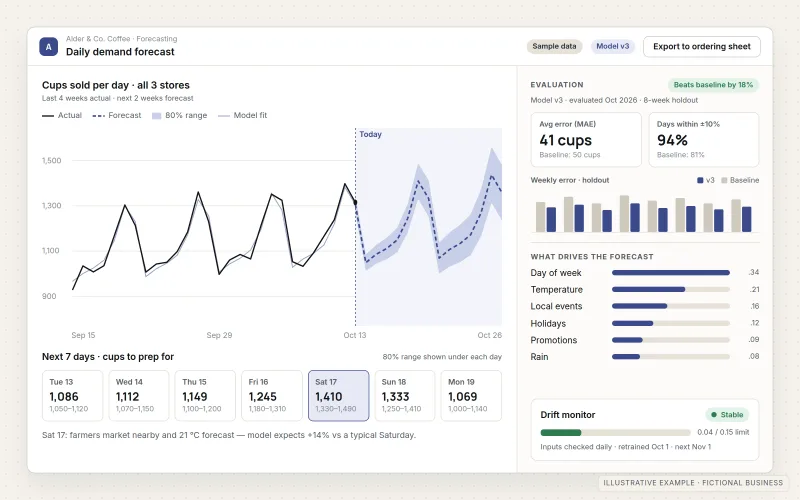
What IOPIA provides
What the work includes
- 01
Problem definition
The decision the model supports, what it predicts, how often, and the metric that will decide whether it is useful.
- 02
Data suitability assessment
A written review of whether the available history is large, clean and relevant enough — including a clear recommendation not to proceed when it isn't.
- 03
Baseline first
A simple rule or average to beat, so any model has to show a measurable improvement before it is worth the extra complexity.
- 04
Model development and evaluation
Candidate models trained on past data and scored on a held-out period or sample, with results and limitations explained in plain language.
- 05
Deployment
Predictions delivered as scheduled batch scores into a spreadsheet, database or CRM, or through a small API that existing systems can call.
- 06
Monitoring and retraining
Checks for drift in the incoming data and in model performance, with retraining on fresh data when results slip below the agreed level.
Problems solved
When this helps
- Stock, staffing or cash planning relies on last year's numbers and a gut feeling.
- Staff sort incoming requests, transactions or records by hand into categories that follow a pattern.
- Unusual orders, payments or sensor readings are only noticed after they have caused a problem.
- A vendor promised an AI model, but nobody could show how well it worked on the business's own data.
Who it's for
- Businesses with a meaningful history of transactions, orders, bookings or operational records
- Teams making the same forecast or classification decision repeatedly
- Businesses that already have a reporting database or clean exports and want to go beyond describing the past
A good fit when a repeated decision could be improved by a better estimate, there is enough relevant historical data, and someone will act on the predictions.
Not the right service when the goal is answering questions in plain language from documents — see AI Assistants & Chatbots — or when the steps follow fixed rules that can simply be written down, which is Workflow & Business Process Automation.
How it works
From business data to monitored predictions
Select a part of the diagram to see what it does.
- Historical records from the business's own systems are assessed and prepared.
- A simple baseline sets the level any model has to beat.
- Candidate models are trained and scored on held-out data the model has not seen, against the agreed metric.
- The chosen model delivers predictions as scheduled scores or through an API into existing systems.
- Incoming data and performance are monitored for drift, and the model is retrained when results slip.
Scope
Included, and not included
Included
- Discovery: the decision, the target, the users and how success will be measured
- Data suitability assessment, with a recommendation to stop when the data isn't sufficient
- Data preparation and feature design from the business's own records
- A simple baseline and candidate models compared on held-out data
- Evaluation report against the agreed metrics, including where the model performs poorly
- Deployment as batch scoring or an API into existing systems
- Drift monitoring, performance checks and retraining as a managed option
Not included
- Any promise of a particular accuracy or business result — performance is measured and reported, not assumed
- Training large language models or other foundation models
- Open-ended research projects without a defined decision and metric
- Fully automated decisions about individuals, such as credit or hiring, without human review
Not sure where your project sits? Contact us about scope — we'll say plainly what fits.
Implementation
How implementation works
Frame the decision
Agree what will be predicted, who will use it, and the metric and threshold that make it worth deploying.
Assess the data
Check volume, history, quality and leakage risks, and decide together whether to continue.
Baseline and build
Set a simple baseline, then develop models and keep only those that beat it on held-out data.
Deploy
Deliver predictions where people already work, as scheduled scores or through an API.
Monitor and retrain
Track data drift and performance, and retrain or retire the model when the evidence says so.
- Project — a one-time implementation with a defined scope.
- Managed — a recurring service after launch.
- Custom — larger work that starts with discovery.
Technologies
Platforms that may be involved
Tools are chosen to fit the data and where the predictions need to go. A project may use:
- Python with widely used libraries such as pandas, scikit-learn and gradient-boosting packages
- SQL against your reporting database or data warehouse
- Cloud machine learning services from providers such as AWS, Microsoft Azure or Google Cloud
- Scheduled cloud jobs for batch scoring, or a small API for on-demand predictions
- Experiment tracking and model versioning so results can be reproduced
Platform names are used to describe the work. They do not indicate a partnership or certification.
Questions
- How is this different from an AI chatbot?
- A chatbot uses a language model to hold a conversation and answer from written content. Machine learning here means a model trained on your own numerical or categorical records to make a specific prediction, such as next month's demand or whether a transaction looks unusual.
- How much data do we need?
- It depends on the problem, how often the pattern repeats and how noisy the data is. The suitability assessment answers this for your case, and if the data isn't sufficient, IOPIA will say so and suggest what to collect first.
- How accurate will the model be?
- That can't be known in advance. Performance is measured on held-out data against the agreed metric and compared with a baseline, and the results — including where the model is weak — are shared before deciding to deploy.
Discuss Machine Learning Solutions with IOPIA.
Describe the project or problem in your own words. Early-stage conversations are welcome — you don't need a finished brief.