
AI, Automation & DataData Collection & Integration
Web scraping and data collection
Collecting publicly available or permitted information from websites, portals and documents on a schedule, cleaned and delivered to the spreadsheet, database or CRM where your team already works.
Contact us about this serviceWhat it looks like
An example of the finished work
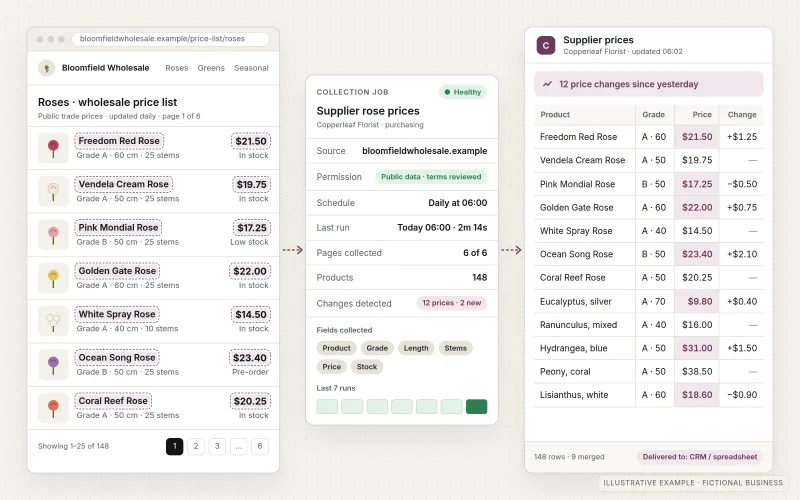
What IOPIA provides
What the work includes
- 01
Source permission review
Each source checked for its terms of service, robots.txt rules and any official API or data export it offers, with the findings written down for your decision.
- 02
Field specification
A written list of the exact fields to collect, where each one comes from on the page or document and what format it should arrive in.
- 03
Collection jobs
Scripts that request pages at a considerate rate, read the agreed fields and extract tables or text from PDFs and other documents.
- 04
Cleaning and de-duplication
Names, dates, prices and addresses standardized, repeat records merged and incomplete rows set aside for review.
- 05
Scheduling and change monitoring
Collection run daily, weekly or on another agreed schedule, with notices when a tracked value changes or a page layout stops matching.
- 06
Delivery to your systems
Records written to a spreadsheet, cloud database or CRM, with a short run log showing what was collected and what was skipped.
Problems solved
When this helps
- Someone copies prices, listings or product details from several websites into a spreadsheet by hand every week.
- Public tender notices, permit records or supplier catalogs change often, and updates are noticed too late.
- Information arrives as PDFs or portal pages that can't be filtered, sorted or reported on.
- An old scraping script stopped working when a site changed, and nobody knows how it was built or whether it was allowed.
Who it's for
- Businesses that track public pricing, product availability or listings across several websites
- Teams that monitor public notices, registers or published catalogs for changes
- Businesses whose own supplier or trade portals offer no export, where they have authorized access
A good fit when the information is publicly available or the business is permitted to access it, the fields needed are clear, and there is a destination ready to receive the results.
Not the right service when the source system offers an API or supported integration — see API & System Integration — or when the data is already collected and the need is a reporting warehouse and scheduled pipelines, which is Data Engineering.
How it works
Collecting permitted data on a schedule
Select a part of the diagram to see what it does.
- Each source is checked first for its terms, robots.txt rules and any official API or export it offers.
- Only sources that pass the check are read by the scheduled collection job, at a considerate rate.
- Collected records are cleaned, standardized and de-duplicated.
- The results are delivered to the business's spreadsheet, database or CRM.
- When a tracked value changes or a page layout stops matching, a named person receives an alert.
Scope
Included, and not included
Included
- Review of each source's terms of service, robots.txt and any official API or export offered instead
- Collection from login-protected portals only through the business's own authorized access
- Field specification and sample output agreed before the full build
- Collection from web pages, PDFs and other published documents
- Cleaning, standardization and de-duplication of collected records
- Scheduled runs, change monitoring and alerts when a source changes its layout
- Delivery to spreadsheets, cloud databases or a CRM
- Documentation, run logs and maintenance as a managed option
Not included
- Bypassing paywalls, logins, CAPTCHAs, rate limits or any other access control
- Collecting personal data about individuals without a lawful basis the business has confirmed
- Legal advice on whether a particular use of data is permitted; the business confirms its own legal position
- Republishing collected content in ways the source does not allow
Not sure where your project sits? Contact us about scope — we'll say plainly what fits.
Implementation
How implementation works
Define the data
Agree the questions the data has to answer, the sources involved and the exact fields to collect.
Check the sources
Review terms, robots.txt and official APIs or exports, and record which sources are suitable and which are not.
Build a sample
Collect a small sample, clean it and review it with you before running at full scale.
Schedule and deliver
Set the collection schedule, connect the destination and switch on change monitoring and failure alerts.
Maintain
Adjust collection when a source changes its layout, and drop any source whose terms no longer allow it.
- Project — a one-time implementation with a defined scope.
- Managed — a recurring service after launch.
- Custom — larger work that starts with discovery.
Technologies
Platforms that may be involved
Tools depend on the sources and the destination. A collection project may use:
- Python with widely used libraries for requesting and parsing web pages
- Headless browsers for pages that only show content after scripts run
- Document parsing tools for tables and text in PDFs
- Scheduled cloud jobs or serverless functions for recurring runs
- Destinations such as Google Sheets, Excel, PostgreSQL or a CRM
Platform names are used to describe the work. They do not indicate a partnership or certification.
Questions
- Is web scraping legal?
- It depends on the source, the data and how it is used, and IOPIA does not give legal advice. IOPIA reviews each source's terms and robots.txt, prefers official APIs or exports, never bypasses access controls and avoids personal data. The business confirms its own legal position before collection starts.
- What happens when a website changes?
- Collection jobs check that the expected fields are still found. When a layout change breaks that, the run stops for that source and an alert is sent, rather than delivering incomplete or wrong data. Fixes are part of the managed option.
- Can you collect data from a portal we log in to?
- Yes, where the business has its own authorized access and the portal's terms allow automated use. If the portal offers an export or API, that is used instead, because it is usually more reliable.
Discuss Web Scraping & Data Collection with IOPIA.
Describe the project or problem in your own words. Early-stage conversations are welcome — you don't need a finished brief.