
Web & Software DevelopmentWebsites & E-commerce
E-commerce website development
Online stores where customers can find a product, understand it and pay without friction, and where orders reach the business in a form it can fulfill.
Contact us about this serviceWhat it looks like
An example of the finished work
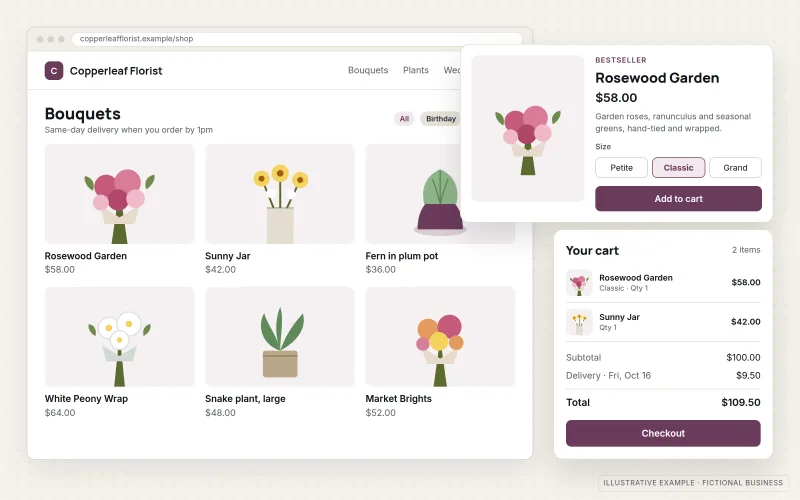
What IOPIA provides
What the work includes
- 01
Platform choice
A recommendation between a hosted store platform and a custom build, based on catalog size, budget for fees and how much control you need.
- 02
Product catalog structure
Categories, variants such as size and color, attributes, filters and product page templates, with your product data imported.
- 03
Cart and checkout
A short checkout with clear shipping costs, taxes and delivery options shown before payment, and guest checkout where appropriate.
- 04
Payments
A payment processor connected so card details are handled by the processor, not stored on your website.
- 05
Order handling
Order confirmation emails, staff notifications and stock levels that update as products sell.
- 06
Commerce tracking
Product views, add-to-cart, checkout and purchase events recorded so sales can be traced back to their source.
Problems solved
When this helps
- Customers abandon the cart when shipping costs or account requirements appear at the last step.
- Orders arrive by email or phone and are typed into another system by hand.
- Products with many sizes or options are hard to manage and hard for customers to choose between.
- The business can't tell which products, pages or ads actually lead to sales.
Who it's for
- Businesses starting to sell products online for the first time
- Retailers whose current store is hard to manage or converts poorly
- Service businesses selling fixed-price packages, gift cards or bookable products
A good fit when customers can choose and pay for something without a conversation first, and the business is ready to fulfill online orders.
If you only need to take payments or deposits on an existing site, Online Payments & Stripe Integration is the smaller step. If customers book time rather than buy goods, see Booking & Scheduling Systems.
How it works
From product page to fulfilled order
Select a part of the diagram to see what it does.
- A shopper arrives and compares products, choosing a variant that is in stock.
- The cart shows shipping and tax before payment, so there are no surprises at the last step.
- Checkout sends the payment to an external processor, which handles the card details.
- A confirmed order is recorded, stock is reduced, emails go to the customer and the business, and the sale is tracked to its source.
Scope
Included, and not included
Included
- Platform recommendation and store setup
- Catalog structure, product templates and data import
- Responsive store design within your existing brand
- Cart, checkout, shipping and tax configuration
- Payment processor connection and test transactions
- Order confirmation and staff notification emails
- Product structured data and on-page search foundations
- Commerce event tracking and analytics
Not included
- Product photography, product descriptions and pricing decisions
- Warehousing, packing, shipping or other physical fulfillment
- PCI compliance certification or legal review of terms and tax settings
- Any promise of specific sales volumes or conversion rates
Not sure where your project sits? Contact us about scope — we'll say plainly what fits.
Implementation
How implementation works
Map the catalog
List products, variants, prices, stock rules and shipping options, and agree how the catalog will be organized.
Choose the platform
Compare hosted and custom options against your catalog, transaction fees and integration needs, and agree one.
Design the buying path
Design category, product, cart and checkout pages, focusing on the steps where customers most often drop out.
Build and connect
Build the store, import products, and connect payments, emails, stock and tracking.
Test real orders
Place test orders across products, discounts, shipping zones and refunds before switching on live payments.
- Project — a one-time implementation with a defined scope.
- Managed — a recurring service after launch.
Technologies
Platforms that may be involved
The store platform depends on the catalog and how much control is needed. Options include:
- Hosted store platforms such as Shopify
- WooCommerce on WordPress
- Custom storefronts using Stripe Checkout or Stripe Payment Links
- Shipping and tax settings within the chosen platform
- Analytics with e-commerce event tracking
Platform names are used to describe the work. They do not indicate a partnership or certification.
Questions
- Should we use Shopify or have a custom store built?
- For most standard catalogs, a hosted platform is quicker to launch and easier to run. A custom build makes sense when products, pricing rules or integrations don't fit what a hosted platform supports. The recommendation is made after the catalog is mapped.
- Do you store our customers' card details?
- No. Card payments are handled by the payment processor. The store receives a confirmation that the payment succeeded, not the card number.
- Can you move our existing store to a new platform?
- Yes. Products, customers and order history can usually be exported and imported, and old product URLs are redirected so search visibility can carry over.
Discuss E-commerce Development with IOPIA.
Describe the project or problem in your own words. Early-stage conversations are welcome — you don't need a finished brief.