
Digital Marketing & CommerceLead Generation & Conversion
Landing pages for campaigns
Focused pages built for one offer and one action, so visitors who click an ad, email or post arrive exactly where the message promised.
Contact us about this serviceWhat it looks like
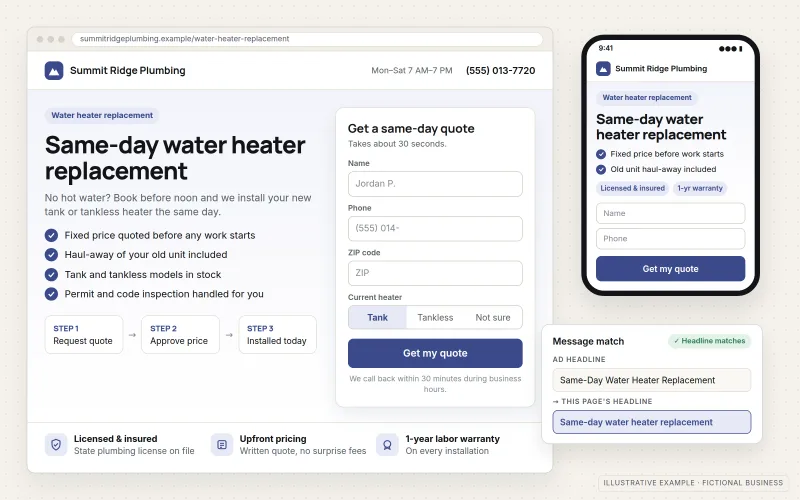
An example of the finished work
What IOPIA provides
What the work includes
- 01
Message match with the ad
The headline, offer and wording on the page repeat what the ad or email promised, so visitors know at once they are in the right place.
- 02
One offer, one action
Each page is built around a single offer — a quote, consultation, estimate or booking — with navigation and distractions kept to a minimum.
- 03
Page structure and copy
Headline, benefits, how it works, common objections and trust details the business can substantiate, in that order.
- 04
Speed and mobile layout
Lightweight pages with compressed images and minimal scripts, laid out first for the phone screens most paid traffic arrives on.
- 05
Form and call placement
The form or click-to-call button placed where visitors look for it and repeated on longer pages.
- 06
Testing where traffic allows
A/B tests of headlines, offers or form length when a page receives enough visits for the results to mean something.
Problems solved
When this helps
- Every ad sends visitors to the homepage, where the advertised offer is hard to find.
- The page says something different from the ad, so visitors leave within seconds.
- Campaign pages load slowly on phones or push the form below a wall of text.
- Building a new page for each promotion takes weeks or needs a developer every time.
Who it's for
- Businesses running Google, Meta or email campaigns that need a page for each offer
- Service businesses promoting a specific service, season or location
- Teams testing offers without changing the main website
A good fit when there is a defined offer, a traffic source pointing at it and someone ready to respond to the inquiries the page produces.
Not the right service when the whole company website needs planning or rebuilding — see Business Website Development. If pages exist but inquiries are lost after submission, see Lead Generation Systems.
How it works
Anatomy of a campaign landing page
Select a part of the diagram to see what it does.
- An ad or email makes a specific promise, such as a free estimate for one service.
- The landing page opens with a headline that repeats that promise in the same words.
- Benefits, how it works and trust details answer the questions a visitor has before acting.
- A single form or call button, easy to reach on a phone, asks for the next step.
- The resulting inquiry is passed to the business's lead generation system for routing and follow-up.
Scope
Included, and not included
Included
- Offer and audience brief for each page
- Copy written to match the ads or emails that point to it
- Page design within the existing brand
- Responsive build tested on phones, tablets and desktops
- Performance work on images, fonts and scripts
- Accessible structure: headings, contrast, labels and keyboard use
- Form or call action connected to the business's chosen destination
- A/B test setup and review where traffic is sufficient
Not included
- Routing, CRM handoff and follow-up after submission — see Lead Generation Systems
- Tag and conversion setup across platforms — see Conversion Tracking
- Running or optimizing the ad campaigns — see Google Ads Management or Meta Ads Management
- Promised conversion rates or inquiry volumes
Not sure where your project sits? Contact us about scope — we'll say plainly what fits.
Implementation
How implementation works
Brief
Agree the offer, the audience, the traffic source and the single action the page should produce.
Write
Draft the headline and copy against the actual ad or email text, so both say the same thing.
Design and build
Lay out the page for phones first, then build it with attention to load time and accessibility.
Check before launch
Test the form or call action, page speed and layout across devices, and confirm the page is ready for tracking.
Review and test
Watch visitor behavior once traffic arrives, then refine copy or test where volume allows.
- Project — a one-time implementation with a defined scope.
- Managed — a recurring service after launch.
Technologies
Platforms that may be involved
Landing pages can be built on:
- The business's existing website platform or content system
- A lightweight static build hosted alongside the main site
- Dedicated landing page builders where the business already uses one
- Page speed and accessibility testing tools
- Experimentation tools for A/B testing
Platform names are used to describe the work. They do not indicate a partnership or certification.
Questions
- How is a landing page different from a page on our website?
- A website page explains a service among many and links widely. A landing page is built for one campaign and one action, so it removes most navigation and keeps the visitor focused on the offer the ad described.
- Do we need a separate landing page for every ad?
- Usually one per distinct offer or audience. Ads that promise the same thing can share a page; ads that promise different things should not. A/B testing is added only where a page receives enough visits for results to be meaningful.
Discuss Landing Pages with IOPIA.
Describe the project or problem in your own words. Early-stage conversations are welcome — you don't need a finished brief.