
Digital Marketing & CommercePaid Advertising
Meta ads management
Planning and managing Facebook and Instagram advertising that reaches the right people, captures inquiries and is measured accurately.
Contact us about this serviceWhat it looks like
An example of the finished work
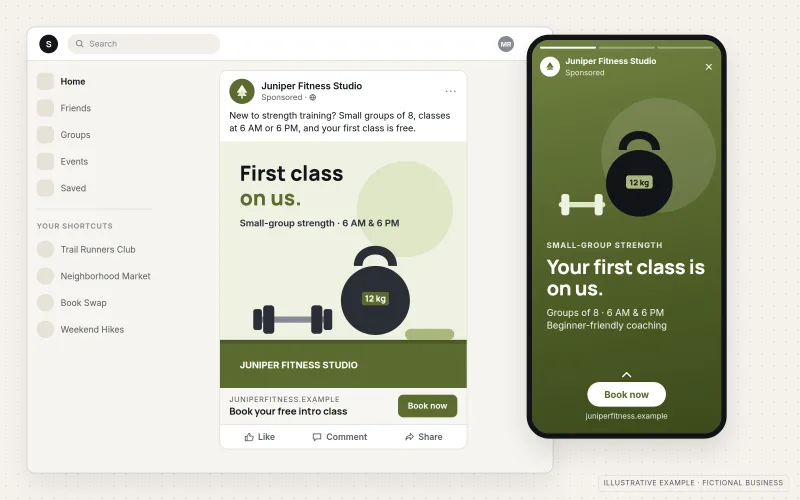
What IOPIA provides
What the work includes
- 01
Campaign objectives and structure
Campaigns, ad sets and ads arranged around one objective each — usually leads or website conversions — so results are easy to compare.
- 02
Audience planning
Location, interest and lookalike audiences, plus retargeting of website visitors where the business's consent settings allow it.
- 03
Ad copy and format setup
Ad text, headlines and calls to action written for the audience, using images or video the business supplies, in formats suited to each placement.
- 04
Lead forms and destinations
Instant lead forms inside Facebook and Instagram, or links to a dedicated landing page, with the questions that help qualify an inquiry.
- 05
Pixel and Conversions API
The Meta Pixel and server-side Conversions API configured so form submissions, bookings and purchases are reported back to campaigns.
- 06
Testing, optimization and reporting
Structured tests of audiences and messages, budget adjustments based on results, and a clear report on cost and quality of inquiries.
Problems solved
When this helps
- Posts get boosted, but there is no evidence any of it produces customers.
- Lead form entries sit in Facebook and nobody follows up quickly.
- Ads reach a broad audience with no connection to where the business actually works.
- Recent privacy changes left the Pixel reporting far fewer conversions than really happen.
Who it's for
- Local and regional service businesses whose customers spend time on Facebook and Instagram
- Businesses with an offer that people respond to before they actively search, such as consultations or seasonal services
- Businesses already running Meta ads that want clearer structure and measurement
A good fit when the business has a clear offer, can supply images or video, and wants to reach likely customers who may not be searching yet.
If customers mainly search for the service when they need it, Google Ads Management is often the stronger starting point. Day-to-day social posting and design work are not part of this service.
How it works
How a Meta campaign is measured
Select a part of the diagram to see what it does.
- A campaign is built around a single objective, such as generating inquiries for one service.
- Ad sets define who sees the ads, and the ads appear to that audience on Facebook and Instagram.
- People who respond complete an instant lead form or continue to a landing page.
- The Meta Pixel and Conversions API record that action so the campaign can learn which people respond.
- Reporting compares cost and lead quality across ad sets, and budget moves toward what works.
Scope
Included, and not included
Included
- Business portfolio, ad account and Page access review, or setup of customer-specific accounts with authorization
- Campaign, ad set and ad structure by objective
- Audience definition, exclusions and retargeting where consent allows
- Ad copy and setup of supplied images or video
- Instant lead forms or landing page destinations
- Meta Pixel, Conversions API and event configuration
- Budget pacing, creative and audience testing
- Regular reporting with recommendations
Not included
- Organic social media management, posting or community replies
- Graphic design, photography, video production or branding
- Ads that break Meta's advertising standards, including special ad category rules
- Promised results or a fixed number of leads
Not sure where your project sits? Contact us about scope — we'll say plainly what fits.
Implementation
How implementation works
Clarify the offer
Agree the objective, the audience, the service areas and the specific offer the ads will present.
Set up measurement
Check account access, then configure the Pixel, Conversions API and events before any budget is spent.
Build campaigns
Create the campaign structure, audiences, ads and lead forms or landing page links.
Test
Run a small number of deliberate variations in audience or message so the results show what to keep.
Optimize and report
Shift budget toward what produces quality inquiries, refresh fatigued ads, and report on results.
- Project — a one-time implementation with a defined scope.
- Managed — a recurring service after launch.
Technologies
Platforms that may be involved
Meta ads work typically involves:
- Meta Ads Manager and Meta Business Suite
- Meta Pixel and Conversions API
- Facebook and Instagram instant lead forms
- Google Tag Manager and Google Analytics 4
- The business's landing pages and CRM
Platform names are used to describe the work. They do not indicate a partnership or certification.
Questions
- Who owns the ad account and the Page?
- The business portfolio, ad account, Page and Pixel are set up for the business — existing ones, or new customer-specific ones created with its authorization — and IOPIA works on them through partner access. The agreement records who owns each asset, who has administrative access and who is billed for ad spend, which is paid to Meta and is separate from IOPIA's fees. Meta's own terms and verification requirements apply.
- Do we need to provide our own images or video?
- Yes. IOPIA writes the ad copy and sets up the ads, but design and production are not part of this service. Genuine photos of the business's work often perform well.
- Where do lead form entries go?
- They can be sent automatically to the business's CRM or email so someone can follow up promptly, instead of sitting inside Facebook.
Discuss Meta Ads Management with IOPIA.
Describe the project or problem in your own words. Early-stage conversations are welcome — you don't need a finished brief.