
Cloud & InfrastructureHosting, DNS & Edge
Website and application hosting
Choosing, setting up and managing where websites and web applications run — for speed, security and straightforward recovery.
Contact us about this serviceWhat it looks like
An example of the finished work
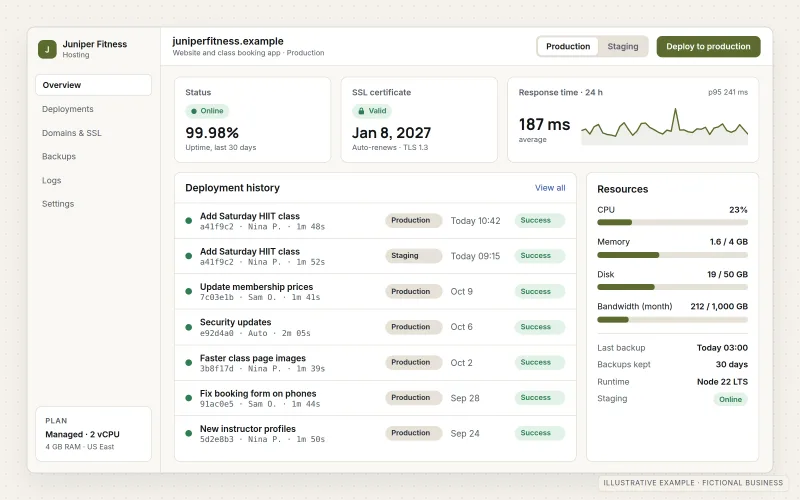
What IOPIA provides
What the work includes
- 01
Platform selection
Static, edge, managed or server hosting chosen to suit the site and its traffic.
- 02
Deployment setup
A repeatable way to publish changes, with preview environments where useful.
- 03
DNS and SSL
Domain records and certificates configured so the site is reached securely.
- 04
Performance
Caching, compression and content delivery set up for fast page loads.
- 05
Security baseline
HTTPS everywhere, security headers and access to hosting accounts limited to the right people.
- 06
Monitoring and backups
Availability monitoring and backups with a documented restore procedure.
Problems solved
When this helps
- The site is hosted somewhere nobody remembers signing up for.
- Pages load slowly, especially on mobile.
- Publishing a change means editing files directly on a live server.
- Nobody knows how to restore the site if something goes wrong.
Who it's for
- Businesses launching a new website or web application
- Sites on outdated or poorly understood hosting
- Teams that need a safer way to publish changes
A good fit when a website or application needs reliable, documented hosting with a clear way to deploy and recover.
Designing a whole cloud environment for business systems — staged environments, infrastructure as code, private networks and VPNs — is Cloud Engineering & Architecture and Cloud Networking & Secure Connectivity. Hosting places websites and web applications on a suitable platform and keeps them running.
How it works
A hosting setup
Select a part of the diagram to see what it does.
- Changes are committed to a repository.
- A deployment pipeline builds and checks them before publishing.
- The hosting platform serves the site behind DNS, SSL and caching.
- Monitoring watches availability, and backups are stored separately.
Scope
Included, and not included
Included
- Hosting platform recommendation and setup
- Deployment workflow and preview environments
- DNS, SSL and redirect configuration
- Caching and content delivery
- Security headers and account access
- Availability monitoring and backups
- Hosting documentation
Not included
- Hosting provider charges, billed by the provider or passed through as set out in the agreement
- Changes to the website itself — see Website Management & Maintenance
- Hosting for email, which runs on the email platform
Not sure where your project sits? Contact us about scope — we'll say plainly what fits.
Implementation
How implementation works
Assess
Understand the site, its traffic and how it is published today.
Design
Choose the platform, deployment flow and DNS changes.
Set up
Configure hosting, security headers, caching and monitoring.
Cut over
Move traffic with DNS changes planned to avoid downtime.
Manage
Keep hosting, certificates and backups maintained.
- Project — a one-time implementation with a defined scope.
- Managed — a recurring service after launch.
Technologies
Platforms that may be involved
Depending on the site, hosting may use:
- Cloudflare Workers and static asset hosting
- Static-site and edge hosting platforms
- Managed application hosting
- Virtual private servers where a full server is genuinely needed
Platform names are used to describe the work. They do not indicate a partnership or certification.
Questions
- Is hosting included in the price of a website?
- Hosting setup is part of a website project. The hosting provider's charges are separate, billed to the business's account or passed through as set out in the agreement.
- Do we need a dedicated server?
- Most business websites don't. Static or edge hosting is usually faster and simpler to maintain; a server is used only when an application genuinely needs one.
Discuss Website & Application Hosting with IOPIA.
Describe the project or problem in your own words. Early-stage conversations are welcome — you don't need a finished brief.