
Web & Software DevelopmentWebsites & E-commerce
Website management and maintenance
Ongoing care for a live website: updates, monitoring, fixes, content changes and performance, handled as a routine instead of an emergency.
Contact us about this serviceWhat it looks like
An example of the finished work
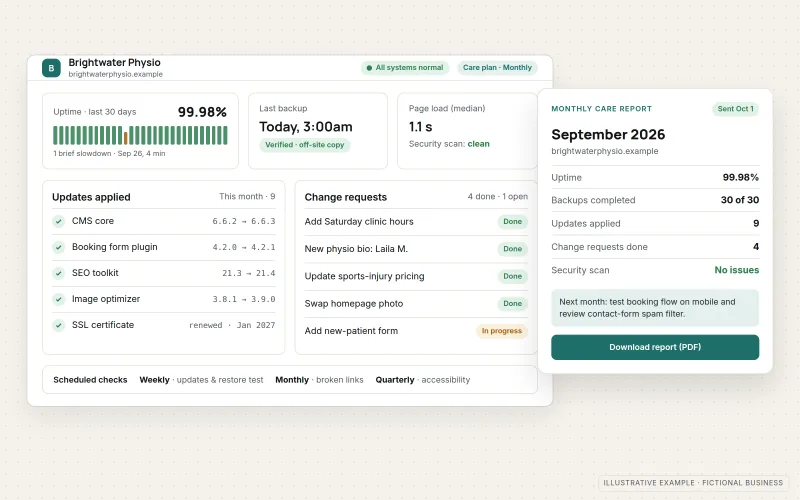
What IOPIA provides
What the work includes
- 01
Updates
Framework, plugin and dependency updates applied and checked on a regular schedule.
- 02
Monitoring
Availability and error monitoring, so problems can be caught before visitors report them.
- 03
Backups
Scheduled backups of the site and its content, stored separately from the host.
- 04
Content and page changes
Text, image and page updates, plus small layout changes within the existing design.
- 05
Performance care
Page speed and Core Web Vitals reviewed, with improvements made where they matter.
- 06
Change record
A running log of what changed, when and why.
Problems solved
When this helps
- Updates are skipped until something breaks.
- The site goes down and the business finds out from a customer.
- Small content changes wait weeks because there's no one to make them.
- The site has slowly become slower and nobody knows why.
Who it's for
- Businesses with a website but no in-house developer
- Sites built by IOPIA that continue under a managed relationship
- Existing sites built elsewhere, after an initial review of how they are set up
A good fit when the website matters to the business and should be looked after continuously rather than fixed occasionally.
Not a substitute for a redesign when the site's structure or technology no longer fits the business.
How it works
The maintenance cycle
Select a part of the diagram to see what it does.
- Software is updated on a schedule.
- Availability and errors are monitored continuously.
- Backups are taken and stored separately.
- Content and performance are improved as needed.
- Every change is recorded in a change log.
Scope
Included, and not included
Included
- Scheduled software and dependency updates
- Availability and error monitoring
- Scheduled backups and restore procedure
- Content updates and small page changes
- Performance and accessibility checks
- A log of changes
Not included
- New features, new sections or redesigns — scoped as projects
- Advertising or ongoing SEO campaigns
- Hosting costs charged by third-party providers
Not sure where your project sits? Contact us about scope — we'll say plainly what fits.
Implementation
How implementation works
Review
Document how the site is built and hosted, and what needs attention first.
Stabilize
Apply outstanding updates, set up monitoring and confirm backups.
Routine
Updates, checks and backups run on an agreed schedule.
Requests
Content and page changes are handled as they come in.
Report
Periodic summaries of what changed and what is recommended next.
- Managed — a recurring service after launch.
- Project — a one-time implementation with a defined scope.
Questions
- Can you maintain a website you didn't build?
- Usually, after a review. The first step is documenting how the site is built and hosted so updates can be made safely.
- Is hosting included?
- Hosting setup and management can be part of the arrangement; charges from third-party hosting providers are separate.
Discuss Website Management & Maintenance with IOPIA.
Describe the project or problem in your own words. Early-stage conversations are welcome — you don't need a finished brief.